More about learning through play
Learning through play is how children explore the world, build skills, and learn to communicate. Babies and young children learn by looking, touching, moving, and trying things out. As they grow, play becomes more imaginative, like pretending with toys or acting out everyday life. Playing with others also helps them learn how to share, take turns, and use language.
Some children may find it harder to learn through play. This can happen for many reasons, such as differences in development, limited chances to play, or challenges with communication or movement. Every child develops at their own pace, but some may need more time or support to join in and try new types of play. Changes at home, tiredness, or feeling unwell can also affect how a child plays.
If your child is struggling, you might notice they do not explore toys much, repeat the same actions, or find it hard to play with others. They may seem frustrated, lose interest quickly, or avoid pretend play as they get older. This can feel worrying, especially if you are unsure what is typical for their age. You might feel unsure how to help or where to start.
It is a good idea to seek help if you are concerned about how your child is playing or learning. Trust your instincts—if something does not feel right, it is okay to ask. Early support can make a big difference and help your child build skills at their own pace. You are not alone, and guidance is available to help you support your child’s development.
Follow your child’s lead by noticing what they enjoy and joining in, rather than choosing the activity yourself. Try not to ask lots of questions—comment instead, such as “Dolly’s having a drink,” to keep play flowing. Use simple language that matches your child’s level, adding just one or two extra words to support learning. Play alongside and gently show new ideas without taking over. For example, if they move a train back and forth, you could add another train going over a bridge. Children are more likely to copy when they feel relaxed and not pressured to change.
Provide a mix of simple play activities to support your child’s learning. You can hide safe objects in boxes or under cloths for your child to find and explore, or make noise by banging items together. Play movement games like hide and seek, ball games, and simple obstacle courses using everyday items. Encourage pretend play with dolls, animals, or toy sets by acting out everyday routines like feeding or bedtime. Build towers or complete puzzles together to support shared play. Use boxes, dressing up, and role play (such as shops or hospitals) to spark imagination and creativity.


 https://surreychildandfamily.co.uk/wp-content/uploads/2026/06/high-angle-kids-playing-together_23-2150126776-500x333-1.jpg
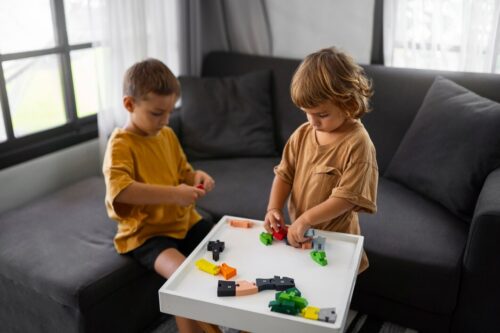
Two young children sit at a small table playing with building blocks.
https://surreychildandfamily.co.uk/wp-content/uploads/2026/06/high-angle-kids-playing-together_23-2150126776-500x333-1.jpg
Two young children sit at a small table playing with building blocks.